Last reviewed: November 22, 2026
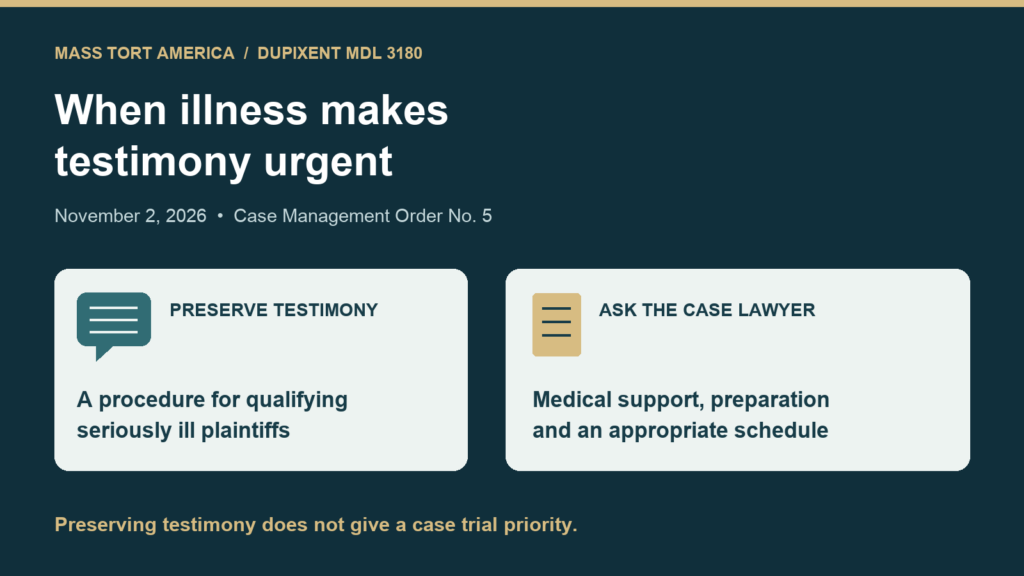
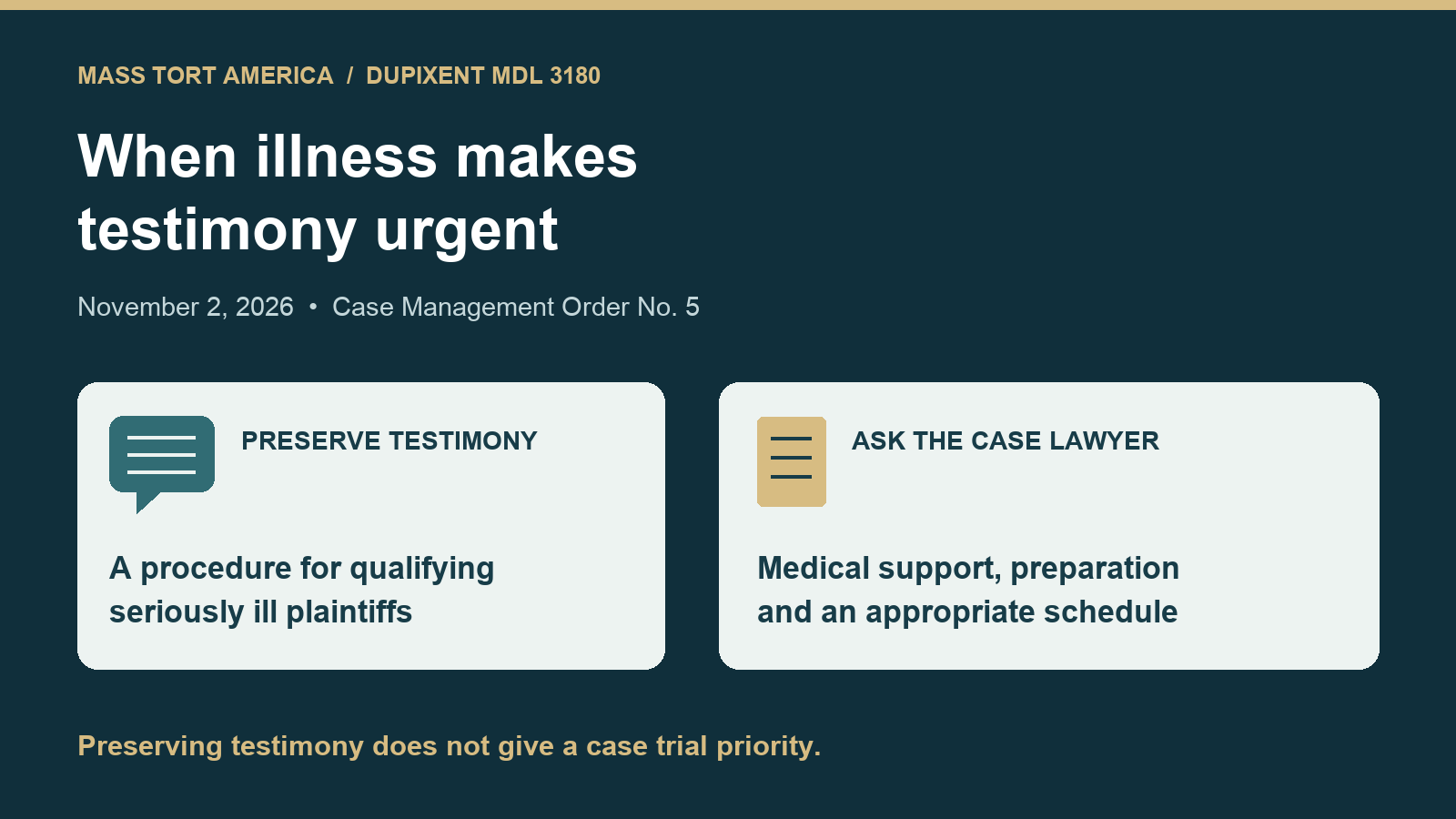
When someone with a Dupixent CTCL lawsuit becomes seriously ill, waiting for a trial may put their testimony at risk. The November 2 order in MDL 3180 gives lawyers a process for preserving it sooner. It does not require a family to predict the patient’s future or arrange a deposition on its own.
Case Management Order No. 5 calls this an “in extremis” deposition. Below, we explain who the order covers, what counsel must arrange and why preserving testimony is different from receiving an earlier trial. Our Dupixent lawsuit hub covers the underlying allegations.
Two different reasons testimony may be urgent
Section II identifies two alternatives. A plaintiff has reached, or is reasonably expected to reach within six months, a condition that prevents competent deposition testimony. Or the plaintiff is reasonably not expected to survive beyond the next 12 months.
The order requires competent medical evidence or a declaration under the specified federal law. It does not say that every CTCL diagnosis meets the test. Nor does it require both alternatives at once. The six-month provision concerns the ability to testify; the twelve-month provision concerns expected survival.
Section I applies to personal-injury cases pending in the MDL and related cases later filed in, transferred to or removed to that court and assigned to the MDL. It expressly leaves Rule 27(a), the separate federal procedure for perpetuating testimony before an action, undisturbed.
If you have only contacted a law firm, ask whether there is an actual lawsuit and which procedure counsel considers appropriate. Do not assume that an intake conversation makes someone an MDL plaintiff. The direct-filing order we explain separately concerns entry into the MDL, not permission to bypass the testimony protocol.
Start with the lawyer who has the case
Tell the lawyer handling the case about a significant change in health and ask whether the plan for testimony should change. That is our practical suggestion, not a court-imposed task for relatives. Ask what supporting information counsel needs from the treating team rather than trying to decide yourself whether the patient meets the order’s medical conditions.
The formal notice goes from the plaintiff’s lawyer to defense counsel as soon as possible after counsel learns of the qualifying condition. Section III calls for:
- A treating-physician or plaintiff declaration under 28 U.S.C. § 1746, and/or recent medical records describing the condition and why an expedited preservation deposition is needed.
- Available medical records about the injuries alleged in the lawsuit, in the plaintiff’s or counsel’s possession, that have not already been produced.
- A suggested date, time and location for the deposition.
Those supporting records serve a different purpose from a family’s general update about a patient’s health. Counsel must connect the request to the condition described in the order.
A video made at home is not the deposition procedure described here. Section VI puts the lawyer who notices the deposition in charge of arranging a court reporter and videographer. Section V says the preservation session follows the federal civil and evidence rules as if conducted at trial.
That distinction helps explain why notice to the other side matters. This is recorded testimony with a formal opportunity for questioning, not simply a family account saved for later.
Ask about both the records timetable and the health timetable
The lawyers must coordinate a date, place and means of taking testimony. More urgent health circumstances can require a different schedule from the ordinary advance-paperwork periods.
Two preparation periods deserve a question to counsel. Section IV.A calls for relevant, agreed medical-record authorizations within ten days of notice and at least 75 days before the earlier deposition. Section IV.C calls for the listed records and discovery materials at least 45 days before the earlier session. The requirements include qualifications, so this summary is not a substitute for counsel reading Section IV in full.
Section IV.C is broader than proof of the urgent condition: it includes the listed medical and damages records and court-approved forms, with conditions on written discovery. Counsel should explain what remains outstanding in this particular case. None of these advance periods is an instruction to wait before reporting a deterioration in health.
Section IV.D tells counsel to consult defense counsel and, if necessary, Magistrate Judge Day or the court before proceeding when the requirements cannot feasibly be met. Section VI permits a more expedited schedule when the medical condition warrants it. The lawyers must address the scheduling problem; a family should not assume the ordinary timetable rules out preserving testimony.
Two sessions, with room for support
There can be two depositions, not just one. Defendants are entitled to conduct a discovery deposition first and have examination priority there. It ordinarily takes place 24 to 72 hours before the trial-preservation deposition. In the preservation session, questioning time is split equally between the plaintiff and defendants.
Section V allows a healthcare provider and/or a friend or family member to attend for physical or emotional support. Ask counsel how that support can be arranged alongside the patient’s care.
The order sets a seven-hour on-record limit for the discovery session, subject to the plaintiff’s ability to proceed, and a six-hour on-record limit for the preservation session, with qualifications for physical inability and additional time. These are not promises that the patient must or will sit through those hours. Counsel should address health-related scheduling with the treating team.
Two questions about objections and timing
Can defendants stop the request simply by objecting?
An objection must follow Section VII. The non-noticing party has seven days after receiving notice to make a good-faith written objection. Counsel must promptly try to resolve the dispute; unresolved objections must reach the court as soon as practicable and within 14 days of receipt of notice. If overruled, the deposition proceeds as soon as practicable as agreed or ordered. An objection is not an automatic denial by the court.
Does the ten-business-day discussion deadline guarantee a deposition then?
No. Section VI sets that period for the parties to meet and confer after notice of the condition and competency to testify. The medical condition may require a faster schedule. The order does not promise that every deposition will occur within ten business days.
What a recorded deposition does not promise
It does not move the plaintiff to the front of the trial line. Section VIII says there is no resulting preference for a bellwether trial, expedited trial or trial pool. Objections to using the testimony remain available under Rule 32 and the evidence rules.
The separate November 2 scheduling order addresses the broader work on general causation. Preserving one person’s testimony does not decide whether Dupixent caused the illness, establish the value of a claim or guarantee that the recording will be used at trial.
Sources
- District of New Jersey: Case Management Order No. 5, November 2, 2026, Sections I–VIII, in extremis testimony protocol.
- District of New Jersey: Case Management Order No. 3, November 2, 2026, Section II, phased discovery.
- Federal Rule of Civil Procedure 32, use of depositions in court proceedings.
Attorney advertising. This article provides general information, not individual legal or medical advice. It does not create an attorney-client relationship. No compensation or outcome is guaranteed. Discuss medication decisions with your treating clinician.

Robert B. Baker, Esq., B.C.S. — Board-Certified Civil Trial Lawyer. 30+ years of trial experience, more than $400 million recovered for clients. About Robert Baker →
This website provides general information. Your circumstances require an individual review.