Last reviewed: November 21, 2026
Two questions belong in the next conversation with your lawyer about an existing Boston Scientific stimulator lawsuit: Has the new short-form complaint been filed? And does it carry forward the claims and individual facts your case needs?
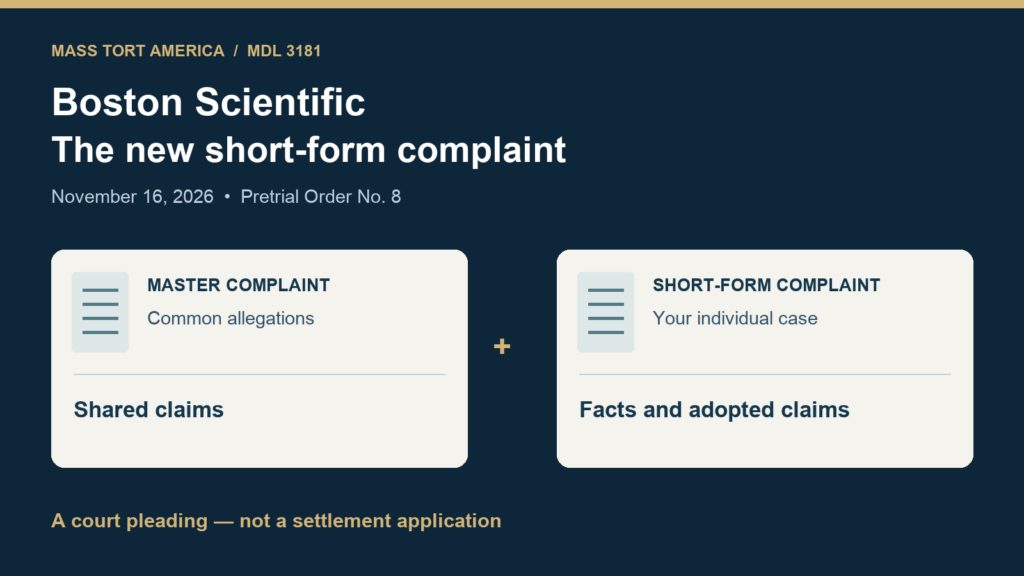
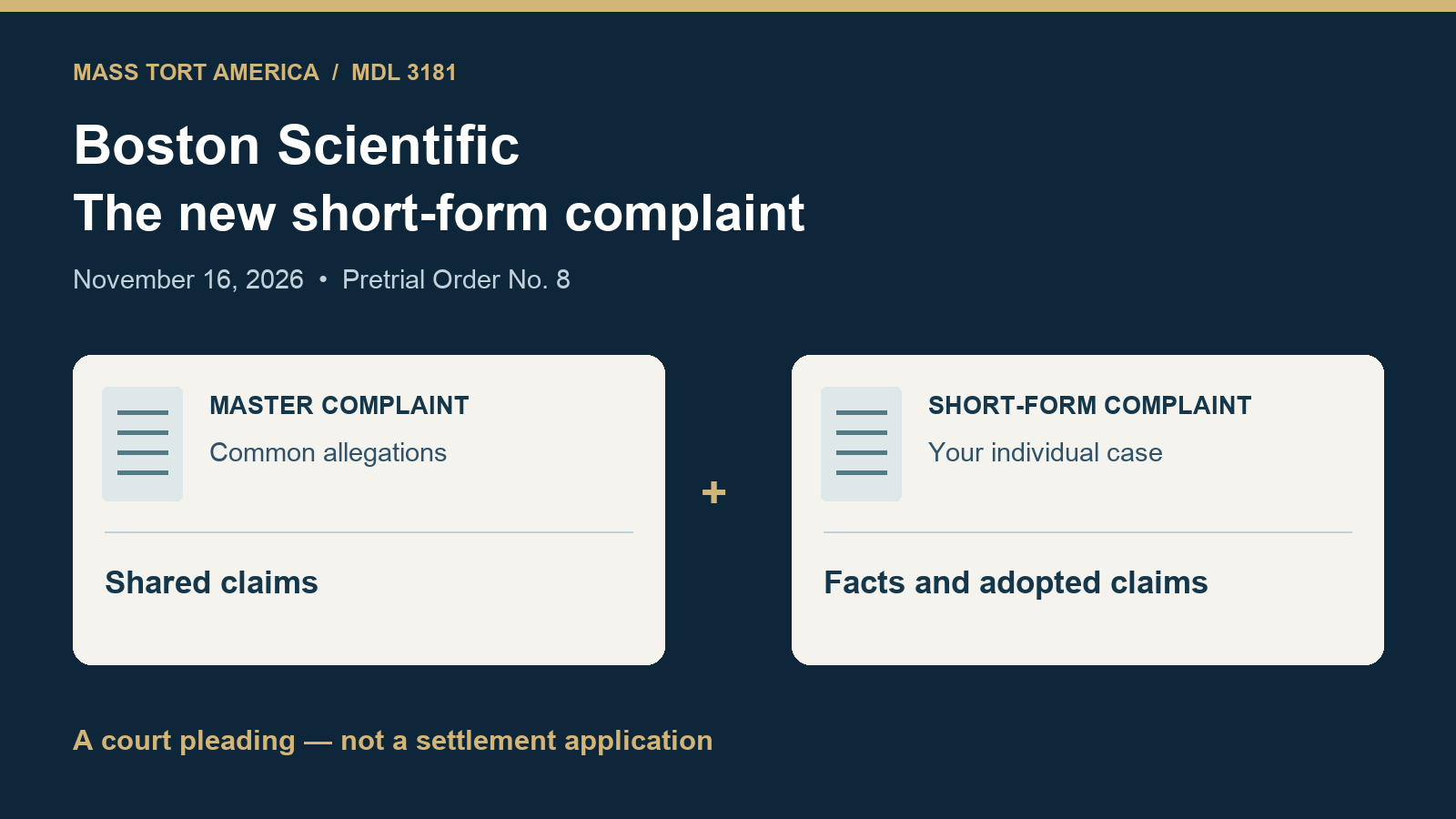
Pretrial Order No. 8, dated November 16, creates the framework for answering both. Judge Josephine L. Staton requires individual short forms in MDL 3181, including for plaintiffs whose original complaints were already transferred or directly filed. She also specifies what the master complaint replaces and what remains of earlier pleadings.
First, confirm the required filing
The order requires a short form within 45 days after entry, or within 30 days after transfer, direct filing or removal of a new action to the MDL, whichever is later. The instruction also reaches each plaintiff named in a multi-plaintiff original complaint: each must file a separate short form.
Your attorney should confirm the applicable date and any extension. We are not calculating a deadline for your case here. The rule is not a universal new deadline for people who have never filed a lawsuit.
There is a possible consequence for failing to file by the applicable deadline or extension: an order to show cause why the case should not be dismissed. That means the plaintiff can be required to explain the failure; it does not mean every delay automatically ends a case.
For the wider proceeding, our Boston Scientific spinal cord stimulator litigation hub is the starting point. The short form is a court pleading, not a settlement application.
What should happen to the facts in your original case?
Ask that question before assuming the new form is merely administrative. Under Section III, the master complaint replaces prior pleadings as to common issues and adopted counts against Boston Scientific when a plaintiff files the short form. Original complaints remain preserved for additional individual allegations that do not conflict with the short form and for determining when the case began, where relevant to timing issues.
The master complaint and short form together become the operative complaint for pretrial purposes concerning those claims. Rulings on adopted common claims bind the plaintiff. Ask counsel which claims the form adopts and whether additional allegations specific to you need to be included.
Boston Scientific retains individual defenses, including arguments about timing, product identification and causation. The order preserves the separate identity of individual actions. Completing a common form does not mean every patient’s circumstances or legal position are the same.
Accurate information matters more than filling every blank
Exhibit A separates trial implantation from permanent implantation and asks about revisions and explant. It also provides for a device that remains implanted and asks whether it is still being used. The form’s listed complications and injuries, including lead migration, shocks and burns, are allegations—not findings about a patient.
If a model number or date is uncertain, tell your attorney. Our direct-filing and device-records guide explains where to begin looking. Do not guess just to finish the paperwork.
What we would want from the case-status conversation is confirmation: the applicable deadline, whether the required short form has been filed, and whether counsel needs anything further to describe the individual case accurately. That is a more useful next step than treating the form as a promise of payment or a reason to change treatment.
Sources
- Pretrial Order No. 8, November 16, 2026, Document 101, especially Sections III, IV, VI and VIII. Court order reproduced by plaintiffs’ liaison counsel’s firm.
- Exhibit A, standardized short-form complaint, Document 101-1, including paragraphs 13–22.
- JPML transfer order, June 5, 2026, establishing the Boston Scientific proceeding.
Attorney advertising. This article is general information, not legal or medical advice, and does not create an attorney-client relationship. No compensation or outcome is guaranteed. Consult your treating clinician before changing device settings, stopping therapy or considering removal.

Robert B. Baker, Esq., B.C.S. — Board-Certified Civil Trial Lawyer. 30+ years of trial experience, more than $400 million recovered for clients. About Robert Baker →
This website provides general information. Your circumstances require an individual review.