Last reviewed: November 17, 2026
If your Dupixent lawsuit is already on file, the new direct-filing order is not an invitation to file it again. That is one of the clearest instructions in Judge Zahid N. Quraishi’s November 2 order for MDL 3180.
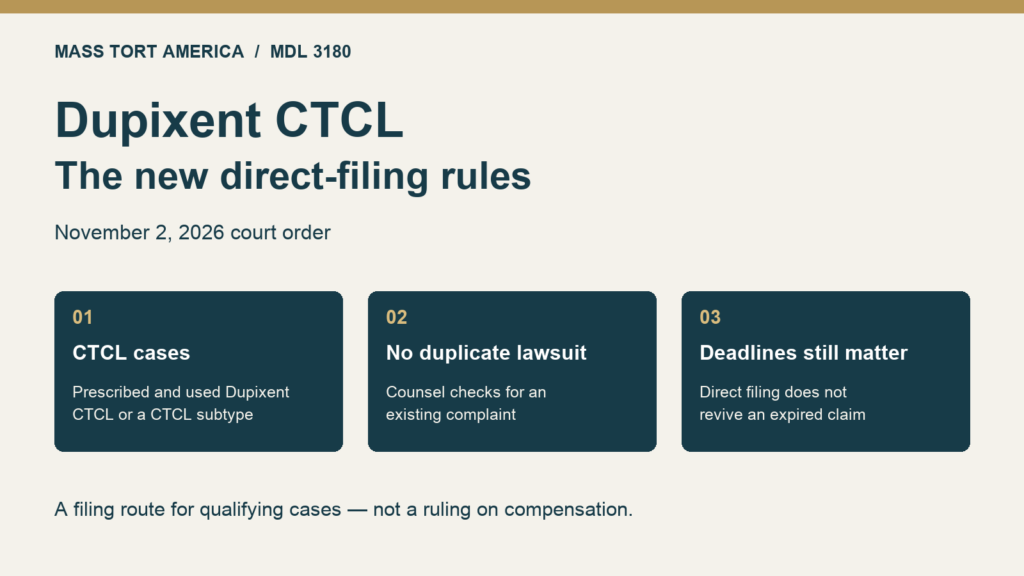
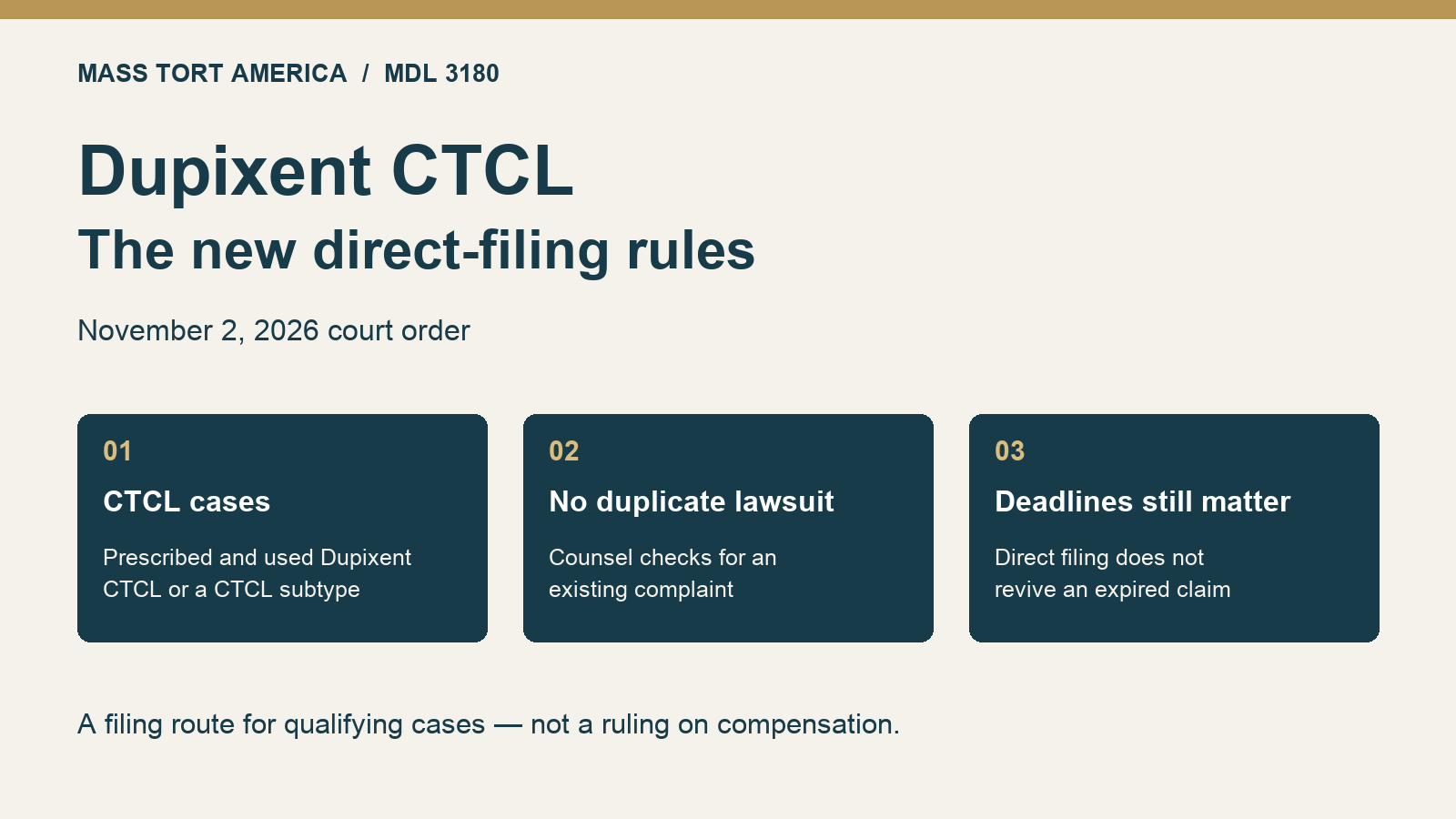
Case Management Order No. 4 allows qualifying CTCL cases to begin in the New Jersey MDL court without first going through a transfer from another federal court. It also tells lawyers to check for earlier complaints, verify the diagnosis and identify where the case would otherwise belong.
We explain the broader claims in our Dupixent lawsuit hub. The immediate question here is narrower: what does this route change for someone considering a lawsuit, or someone who already has one?
Already have a lawsuit? Start with its case number
Before asking whether to use direct filing, ask whether there is already a complaint in your name. A family may know it sent records to a firm without knowing whether the firm has filed suit. The court and case number can resolve that uncertainty.
The November 2 order requires counsel to look in two places: PACER for an earlier federal complaint, and state court through a reasonable inquiry into prior filings. Section II.B says a previous complaint means counsel must not file a new complaint for that same plaintiff in the MDL.
If you have spoken to more than one firm, tell the lawyer handling the matter. Share any complaint or court notice you already have. These are our practical suggestions for that conversation, not extra tasks imposed on patients by the judge. The order directs counsel to conduct the checks.
An existing lawsuit therefore calls for a discussion about that case’s handling, not an assumption that a second filing is necessary to benefit from the MDL.
The order requires CTCL, not just any lymphoma
Start with the actual diagnosis, not an advertisement’s broad use of the word “lymphoma.” Section II.D allows this route only after counsel verifies, on information and belief, that the patient was prescribed and used Dupixent and was diagnosed with CTCL or a CTCL subtype.
The order expressly excludes a patient who never used the drug, even if it was prescribed. It also excludes diagnoses of other diseases or lymphomas without CTCL or a subtype. Counsel should work from the medical record; this article cannot determine a diagnosis.
The geographic scope is limited to U.S. citizens or residents with Dupixent use and CTCL diagnosis in the United States. Meeting those conditions opens a possible filing route, not a guaranteed recovery. Falling outside them does not, by itself, answer every question about a possible claim elsewhere.
There is also a one-patient rule. A directly filed complaint cannot combine unrelated patients. It may include loss-of-consortium plaintiffs where the law permits them, or the appropriate estate representatives in a wrongful-death action.
New Jersey filing does not erase the original court questions
A lawyer filing directly must identify a “Designated Forum” in the complaint’s lead paragraph. That means the federal district where the case would have been filed without this procedure. The complaint must give facts supporting jurisdiction and venue there: why that court can hear the case against those defendants and why it is a proper location.
The order does not settle those questions simply by letting the case start in New Jersey. Defendants may still object. The parties also keep their rights concerning remand for trial, and the direct filing itself does not change the choice-of-law analysis.
The same caution applies to timing. Section VI.E gives direct filing only the deadline-stopping effect that filing in a court with proper jurisdiction and venue would have. It leaves room for a later ruling that a limitations or similar period had already expired.
So the question for counsel is not just “Can we file in New Jersey?” It is also “What is the proper original forum, and is my claim timely there?” The November 2 order supplies no blanket extension.
Filing permission is separate from proving the case
A complaint can enter the MDL without the court having decided whether the drug caused the injury. The November 2 scheduling order illustrates the distinction: Phase I addresses general causation, with remaining company discovery and case-specific discovery in Phase II.
General causation concerns whether Dupixent can cause the alleged injury. It is not the same as deciding what happened to one patient. Direct filing is a procedure for getting qualifying lawsuits into the coordinated pretrial process, not a finding that those lawsuits are proven.
The status-conference calendar is another part of managing that work. Neither a conference nor permission to file directly is a payment date. Defendants retain their defenses under the direct-filing order.
Sources
- District of New Jersey, November 2, 2026: Case Management Order No. 4, direct filing and its limits, particularly Sections I, II and VI.
- District of New Jersey, November 2, 2026: Case Management Order No. 3, phased discovery, Section II.
- District of New Jersey, October 7, 2026: Procedure Order No. 2, status conferences.
Attorney advertising. This article is general information, not individual legal or medical advice. It does not create an attorney-client relationship. Compensation and outcomes are not guaranteed. Talk with your treating clinician before changing any prescribed medication.

Robert B. Baker, Esq., B.C.S. — Board-Certified Civil Trial Lawyer. 30+ years of trial experience, more than $400 million recovered for clients. About Robert Baker →
This website provides general information. Your circumstances require an individual review.