Boston Scientific SCS MDL Now Lists 41 Cases: Why Device Records Matter
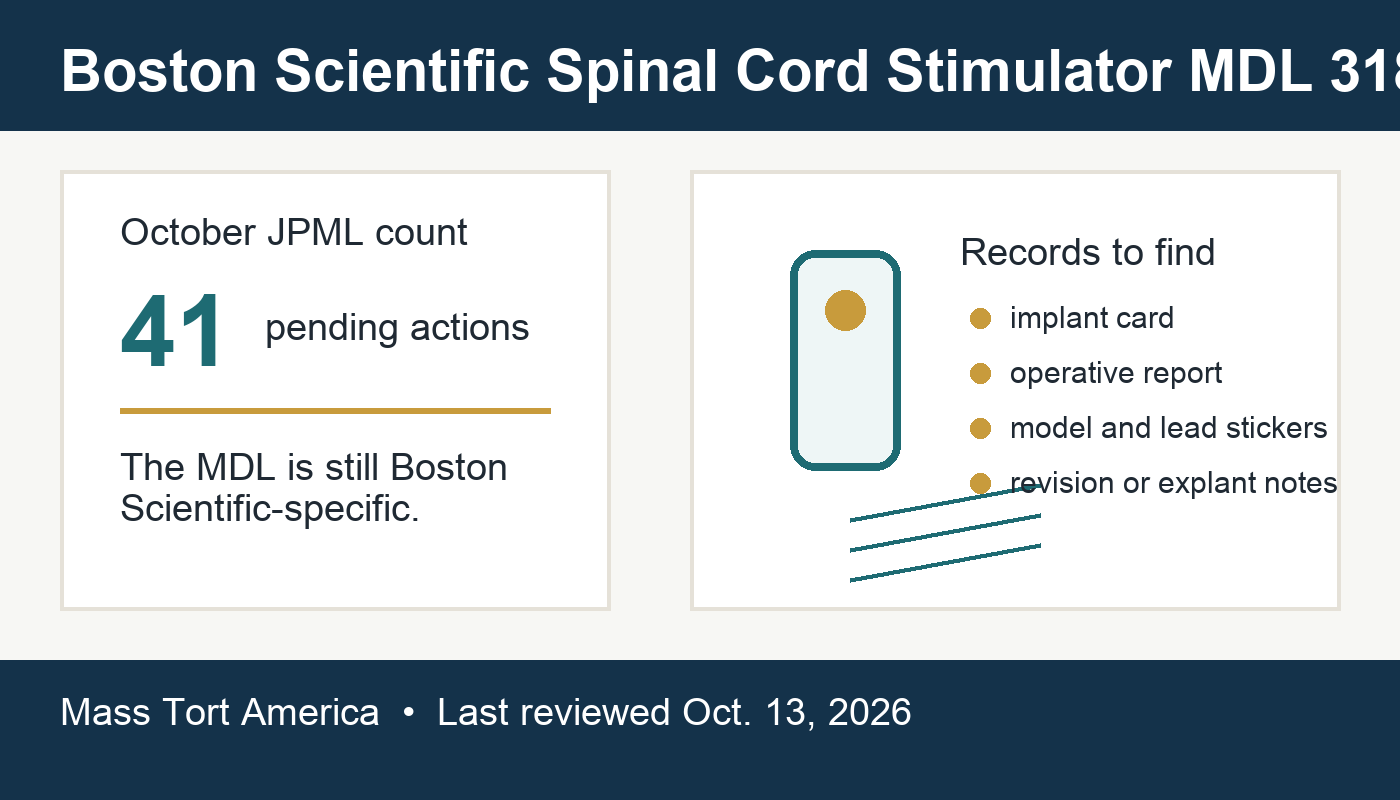
Boston Scientific SCS MDL count moved again. The first question is still the device maker.
Last reviewed: October 13, 2026
The newest JPML report has a small but useful update for Boston
Scientific spinal cord stimulator patients. As of October 1, 2026,
MDL 3181 lists 41 pending federal actions before Judge Josephine L.
Staton in the Central District of California.
That number should be read carefully. It is not a settlement. It is
not a ruling that Boston Scientific is liable. It is not a case-value
estimate. It is a court count.
Still, a court count can matter when a litigation is this new. The
August report listed 26 pending actions. The September report listed
- The October report lists 41. The docket is still small compared
with older medical-device MDLs, but it is no longer just the first
few transferred cases.
Our main Boston Scientific spinal cord stimulator lawsuit
page
explains the broader litigation. This article is narrower. It is
about what the October count means for people trying to organize a
claim review after shocks, burning, lead movement, revision surgery,
or explant.
The count matters less than the record trail
A growing MDL does not make a weak case strong. It also does not make
a strong case automatic. The first useful question is usually much
more ordinary: what device was implanted?
The JPML's June transfer order created a Boston Scientific MDL. It
did not create one national spinal cord stimulator MDL for every
manufacturer. The panel declined, at that time, to transfer the
Abbott cases into the same proceeding.
That line matters because many patients do not know the manufacturer.
They remember the surgery, the remote control, the charging routine,
the jolts, or the day the pain coverage changed. They may not
remember whether the system was Boston Scientific, Abbott, Medtronic,
Nevro, or something else.
For a legal review, that detail cannot stay fuzzy. A Boston Scientific
WaveWriter, Precision, Spectra, or related system may belong on the
MDL 3181 track. A device made by another company may need a different
review path.
Where to look for the manufacturer
Start with the implant card if it still exists. A photo of the card
is fine. If the card is gone, ask the implanting hospital or surgery
center for the operative report and device sticker sheet. Those
stickers often identify the generator, leads, model numbers, serial
numbers, and manufacturer.
Pain-clinic records can help too. Programming notes, interrogation
notes, and reprogramming records may name the generator or lead
system. If a clinic changed names or closed, ask where old records
were transferred. If the chart is hard to get, billing records may
still show dates and providers.
The goal at this stage is not to prove the whole case. It is to stop
relying on memory. A review built on "I think it was Boston
Scientific" is weaker than one built on a device sticker, operative
report, or programming note.
The injury timeline should be built the same way
Once the device is identified, the next question is what happened
after implantation. Useful records may mention shocks, jolts,
burning, overstimulation, charging problems, loss of stimulation,
high impedance, lead migration, lead fracture, revision surgery,
replacement, or explant.
Do not overlook small notes. A portal message about sudden shocks can
matter. A pain-clinic note saying the device had to be reprogrammed
again can matter. An imaging report that mentions lead movement can
matter. None of those records proves a case by itself, but together
they can show the sequence of events.
A simple home timeline helps too. Write down the implant date, when
symptoms started, who adjusted the device, what imaging was ordered,
and when revision or removal was discussed. Keep that timeline
separate from the medical records so the original records stay clean.
For more detail on this part of the paper chase, see our earlier
article on the Boston Scientific SCS direct filing order and records
to gather.
The Infinion CX recall is related, but not a shortcut
The FDA's Infinion CX recall notice is another piece of the factual
background. The notice says Boston Scientific asked customers to
remove unused Infinion CX leads from where they are used or sold. It
also says the lead body may experience mechanical stress at the
anchor site, which may lead to high impedance measurements, lead
fractures, inadequate stimulation, and additional intervention,
including lead explant and replacement.
The same FDA page says the action does not affect devices that have
already been implanted and that no additional patient monitoring
beyond routine clinical follow-up is recommended. That sentence is
important. Patients should not change settings, stop using a device,
or decide on removal because of an article online. Those are medical
decisions for the physician or clinic managing the stimulator.
For legal screening, though, the recall language can help focus the
record search. If the chart mentions Infinion CX, high impedance,
lead fracture, inadequate stimulation, replacement, or explant, those
pages should be pulled into the review. We covered that notice in our
Infinion CX recall explainer.
FAQ
Does the 41-case count mean Boston Scientific settled?
No. It is a JPML pending-action count as of October 1, 2026. It is
not a settlement, verdict, or admission of liability.
What if I do not know whether my stimulator was Boston Scientific?
Ask the implanting facility for the operative report and device
sticker sheet. Programming and interrogation notes may also identify
the generator and leads.
Is explant required for a case review?
Not always. Explant or revision surgery can be important, but reviews
may also consider documented shocks, burning, lead movement, high
impedance, loss of stimulation, neurological symptoms, or a doctor's
recommendation for another procedure.
Should I stop using my spinal cord stimulator?
That is a medical question. Talk with the doctor or clinic that
manages the stimulator before changing settings, stopping use, or
considering removal.
Sources
- JPML pending MDL statistics, Actions Pending report as of October 1, 2026: https://www.jpml.uscourts.gov/sites/jpml/files/Pending_MDL_Dockets_By_Actions_Pending-October-1-2026.pdf
- JPML Pending MDLs page, October 2026 reports: https://www.jpml.uscourts.gov/pending-mdls-0
- JPML Transfer Order, MDL No. 3181, June 5, 2026: https://www.jpml.uscourts.gov/sites/jpml/files/MDL-3181-Transfer_Order-5-26.pdf
- FDA, Spinal Cord Stimulator Recall: Boston Scientific Removes Infinion CX Lead: https://www.fda.gov/medical-devices/medical-device-recalls-and-early-alerts/spinal-cord-stimulator-recall-boston-scientific-removes-infinion-cx-lead
- MDL 3181 court order tracker, Nigh Goldenberg Raso & Vaughn: https://nighgoldenberg.com/boston-scientific-spinal-cord-stimulator-lawsuit-mdl-3181-case-management-orders/
Attorney advertising / informational notice
This article is attorney advertising and is for general information
only. It is not medical advice and does not create an attorney-client
relationship. Prior results do not guarantee a similar outcome. If
you have a spinal cord stimulator and new symptoms, talk with your
medical provider about what to do next.

Robert B. Baker, Esq., B.C.S. — Board-Certified Civil Trial Lawyer. 30+ years of trial experience, more than $400 million recovered for clients. About Robert Baker →