Last reviewed: November 25, 2026
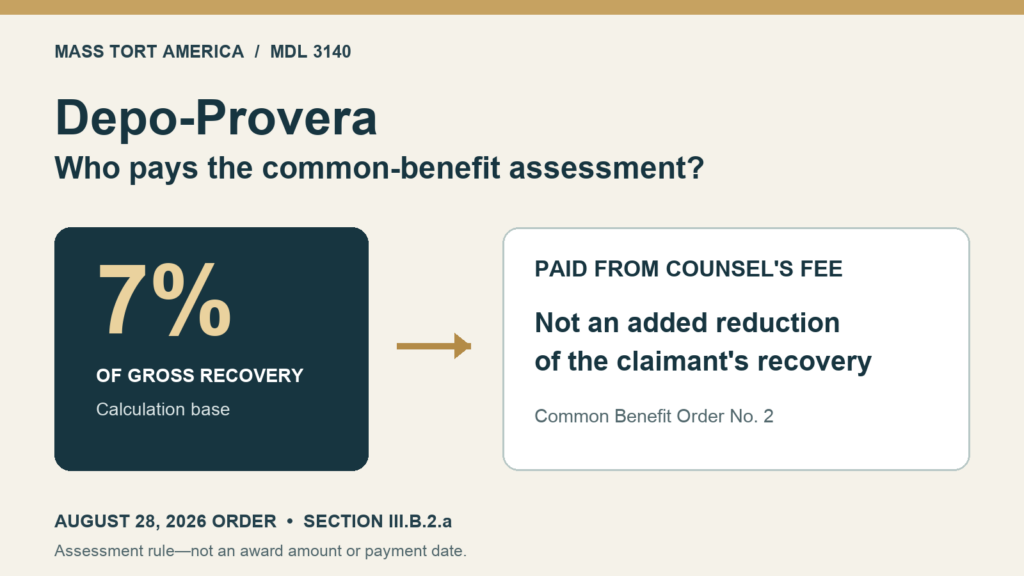
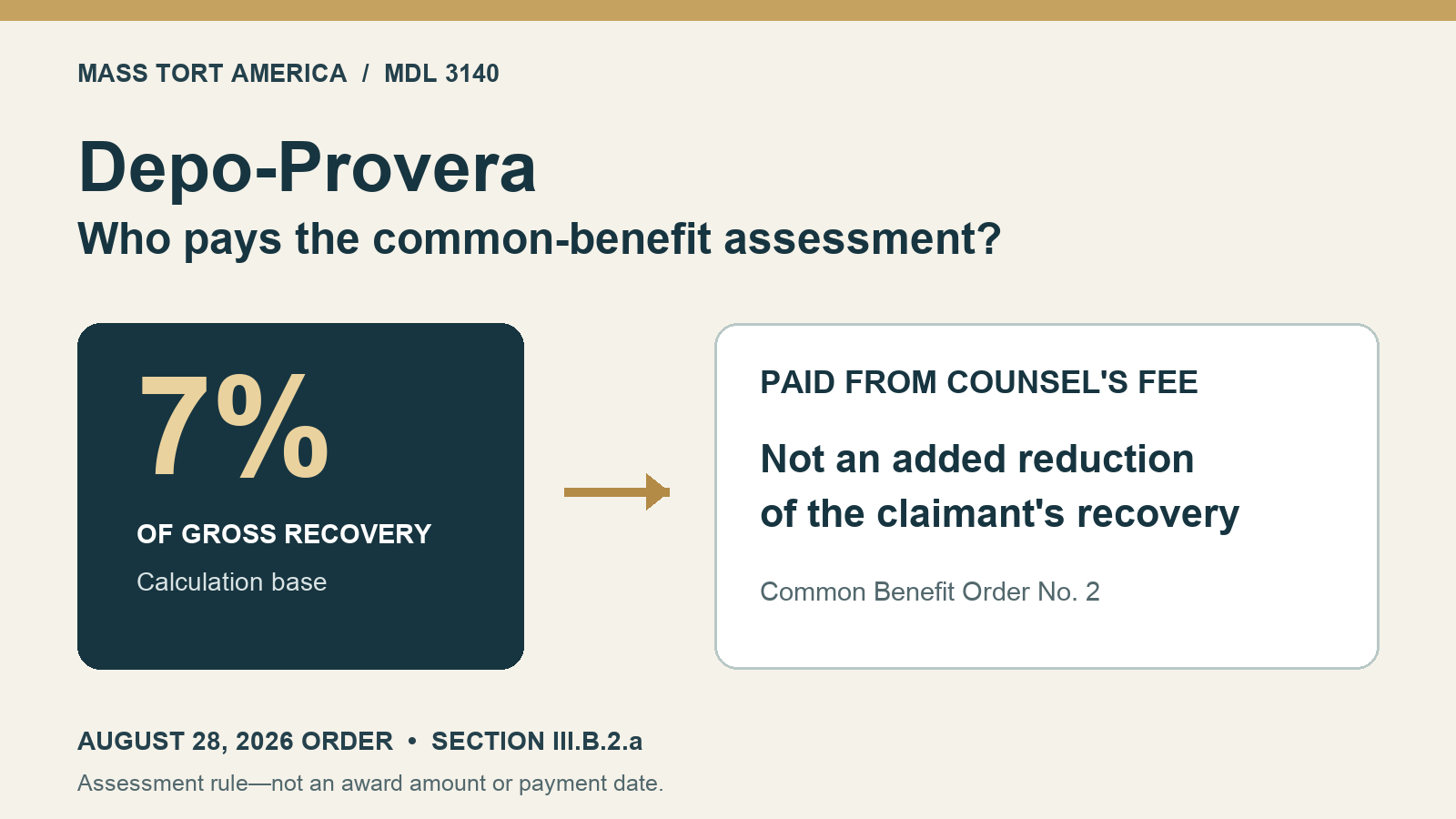
Who pays the seven-percent common-benefit assessment in a covered Depo-Provera case? The lawyer does, from the fee portion of the recovery. Common Benefit Order No. 2 expressly says the assessment must not decrease the claimant’s recovery.
That is a narrow but important protection for a family trying to understand a settlement statement. It does not wipe out medical liens or set the fee in a retainer agreement. Those are different questions, governed by different provisions.
Judge M. Casey Rodgers signed the assessment order on August 28, 2026. The court later approved settlement funds on October 29. We reviewed the posted orders on November 25 to explain the difference between the percentage’s calculation and its payment source—not to announce a new charge or predict anyone’s payment.
Our Depo-Provera litigation hub covers the underlying allegations. Below is the narrower accounting issue and the passages to ask your lawyer about.
Follow both parts of the instruction
Section III.B.2.a of CBO 2 sets seven percent of Gross Monetary Recovery for covered cases in which counsel has a fee interest. It requires payment exclusively from counsel’s fee portion. The sentence continues onto page 6: the assessment “will not under any circumstances decrease the Claimant’s recovery.”
Read “of” and “from” carefully. The assessment is calculated OF the gross recovery and paid FROM the lawyer’s fee. It is not calculated as seven percent of that fee, and it is not a new seven-percent charge to add to the client’s deductions.
The gross-recovery definition in III.B.1 also deserves attention. It excludes court costs paid by defendants and includes specified third-party payments, governmental liens or obligations, and the present value of fixed and certain future payments. Counsel should be able to explain the base shown on the accounting rather than simply point to a total.
Ask where the assessment is shown within counsel’s fee. If the statement appears to charge it separately to you, request an explanation against III.B.2.a before treating that net figure as understood. A confusing label is a reason to ask, not proof of misconduct.
Not every answer is visible in a case caption
The order covers cases already in MDL 3140 and cases later added to it. Section II also covers settlement-program cases, lawyers who sign the participation agreement and other lawyers who obtain common-benefit work product. Ask which provision applies rather than assume the caption settles it.
Exhibit A paragraph 3 explains why a state-court claim can matter: signing counsel’s covered claims include related matters in which they have a financial interest, whether in state or federal court, unfiled, or subject to a tolling agreement. That is conditional coverage, not a statement that all state cases are assessed.
The attached document is an attorney participation agreement for sharing legal work and related obligations. Signing it is not a claimant application step. It also does not replace the agreement between you and your lawyer. Shared discovery or trial preparation may support many cases; your own fee arrangement remains a separate document to discuss.
Keep the medical-lien entries separate
A settlement statement can discuss more than one kind of holdback. The August order calls this assessment a holdback. CMO 17, signed September 4, discusses holdbacks needed to resolve medical-care liens. The same word does not make them the same charge.
Under CMO 17, BrownGreer assists claimants and counsel with identifying and resolving those liens and coordinates with the other administrators over needed reserves. Paragraph 6 says settling claimants pay the costs and expenses of using the Lien Resolution Administrator. That service cost is distinct from the lien being resolved.
For an unexplained entry, ask three things: what is it for, who pays it, and is it final? If it is a common-benefit assessment, the lawyer-fee protection applies under CBO 2. If it is a lien or lien-resolution expense, counsel should explain that separate basis. Neither order provides the amounts for your individual account.
The October 29 settlement-fund order is covered in our fund explanation. Approval of those funds is not approval of an individual award and is not a payment timetable.
Two short questions
Is seven percent my contingency fee?
No. The order sets a common-benefit assessment of gross recovery, payable from counsel’s fee. It does not set your individual fee rate. Ask counsel to show how the retainer and the assessment appear together in the proposed accounting, without charging this assessment again to your share.
Can the common-benefit fund tell me when I will be paid?
Not from this order. Sections IV.C and IV.D address court-approved payments to counsel for shared work and expenses. They do not establish a claimant payment date. Section III.D also treats individual settlement amounts and escrow details as confidential unless the court requests them; a public fund order is not an individual payment statement.
For your own claim, ask for the proposed accounting, identification of provisional entries and an explanation of what remains unresolved. These are suggested questions—not a new deadline, eligibility test or court-required claimant form. Your lawyer should confirm the governing orders and agreements. The assessment does not decide individual causation or guarantee compensation.
Attorney Advertising. General information only, not legal or medical advice. Reading this does not create an attorney-client relationship. Eligibility, compensation and outcomes are not guaranteed. Medical decisions belong with your treating clinician.
Sources
- Common Benefit Order No. 2 and attorney participation agreement, August 28, 2026
- CMO 17: Lien Resolution Administrator, September 4, 2026
- October 29 order establishing the Qualified Settlement and Common Benefit Funds
- Northern District of Florida: MDL 3140 orders by date

Robert B. Baker, Esq., B.C.S. — Board-Certified Civil Trial Lawyer. 30+ years of trial experience, more than $400 million recovered for clients. About Robert Baker →
This website provides general information. Your circumstances require an individual review.