Last reviewed: November 24, 2026
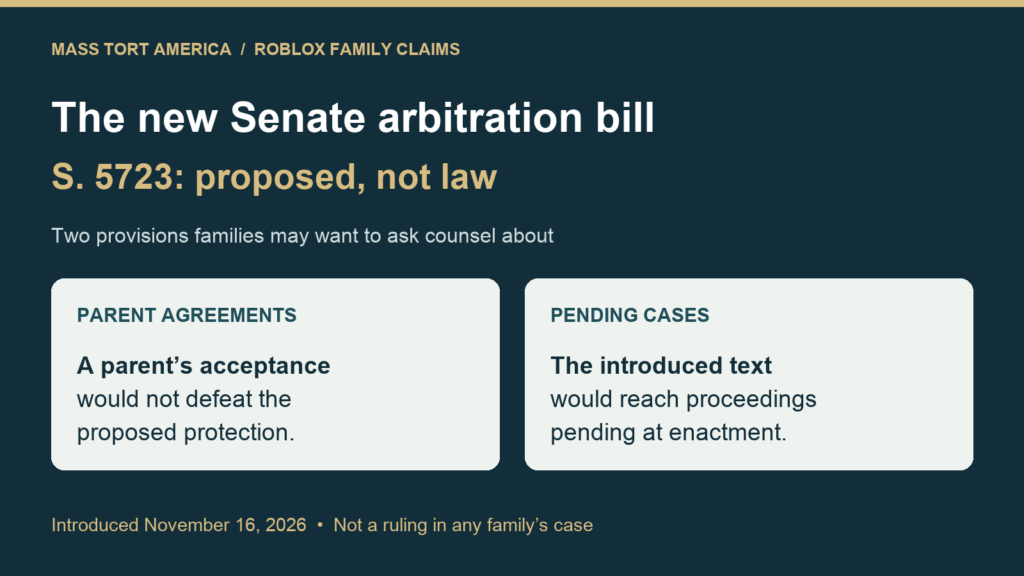
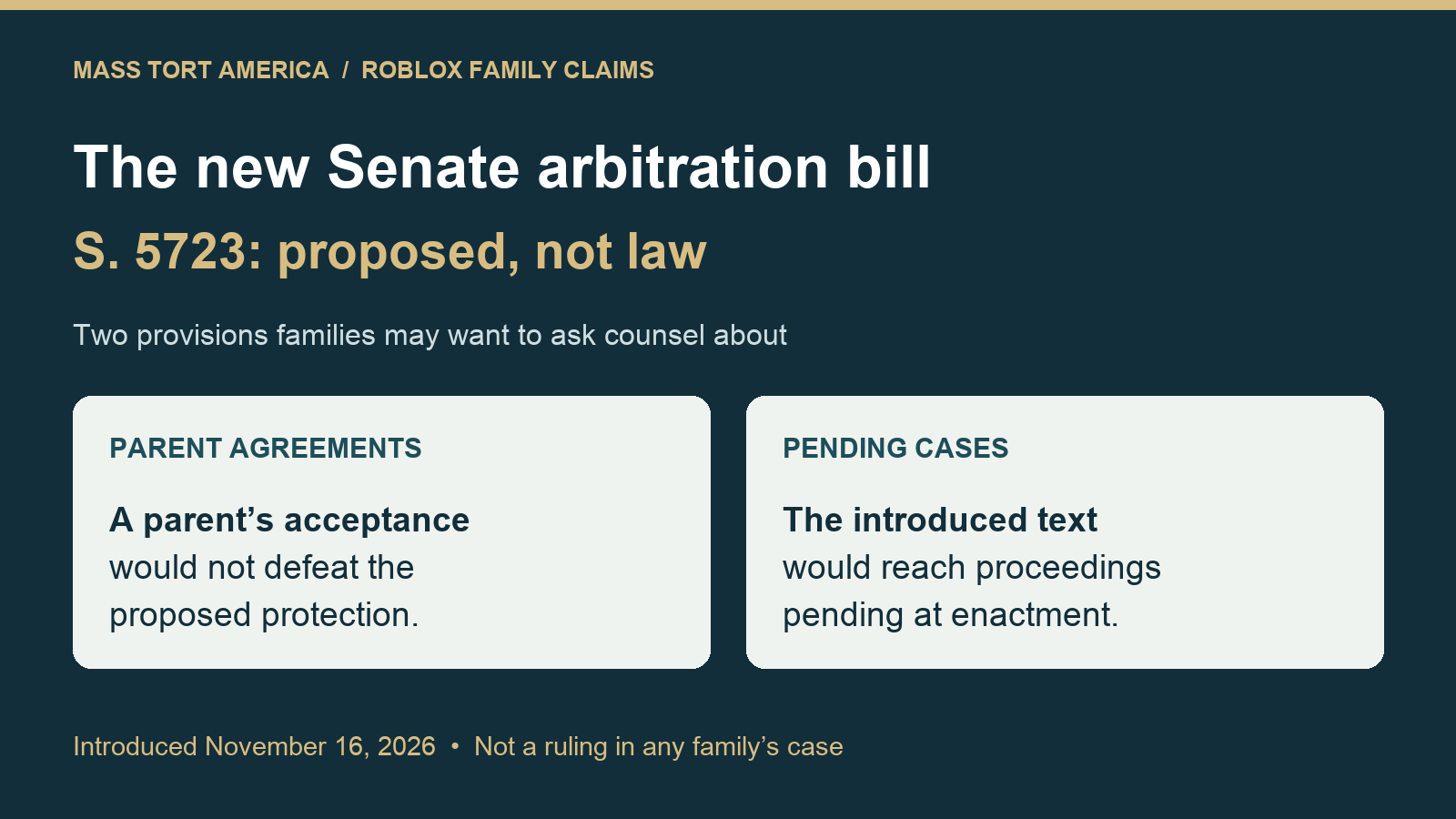
If you accepted Roblox’s terms for your child, would that prevent your family from choosing court instead of arbitration? A new Senate bill proposes a specific protection against that result. Another provision would reach proceedings already pending when the proposal became law.
Neither provision is in force simply because the bill was introduced. Congress.gov lists S. 5723 as introduced and referred to the Senate Judiciary Committee on November 16, 2026. It has not become law. Families should not mistake the news for a ruling in their case or a change to a deadline.
What the November hearing does—and does not—tell families
Senators Josh Hawley and Dick Durbin introduced the No Forced Arbitration for Child Sexual Exploitation and Cyber Injuries Act. A Senate Judiciary subcommittee held a Roblox and online-gaming hearing the next day. The committee’s account describes questions about children and arbitration clauses in account agreements.
A hearing is not a liability decision. To explain the proposed protection, we used the bill’s actual text, not just statements made about it. The discussion below concerns its definitions, parent-agreement provision and applicability section.
The court dispute about agreements made after a claim arose remains a different subject; see our article about later Roblox account terms. An introduced bill does not resolve that dispute or replace a judge’s instructions.
What counts as a covered dispute in the proposal?
S. 5723 is not a Roblox-only bill. It defines child sexual exploitation disputes to include allegations of grooming, enticement or coercion. It separately defines child cyber injury disputes: alleged personal injury caused at least in part by a digital product’s design, features or operation, involving someone who was a minor at the time of the dispute or injury.
The cyber-injury definition expressly includes mental suffering and emotional distress. It would not exclude a dispute just because a third party contributed to the injury. The alleged connection to the product’s design, features or operation still matters.
For a covered dispute, proposed section 502(a) would let the claimant elect against enforcement of a predispute arbitration agreement or joint-action waiver for the related case. “Predispute” refers to an agreement made before the dispute arose. A joint-action waiver restricts participation in joint, class or collective proceedings.
The proposal concerns that choice of process, not an automatic recovery. Its definitions also do not decide which cases belong in MDL 3166. For the allegations underlying those family claims, see our Roblox lawsuit hub.
A parent’s signature, the decision-maker, and the rest of the case
The parent provision is not just about whose name appears on an account. Proposed section 502(c) says a legal representative’s acceptance would have no effect on the protection for a covered dispute involving a minor, regardless of whether the child signed or is otherwise alleged to be bound. A legal representative means a parent or someone qualifying as a legal guardian under state law.
The bill then leaves the applicability decision to a court under federal law. Proposed section 502(b) would do that even if an agreement says an arbitrator gets to decide. A parent asking “Who decides whether this protection applies?” would therefore be asking about a different provision from the one addressing parental acceptance.
There is a third part: section 502(d) would cover the whole case and every claim properly joined by the electing claimant. It does not require each such claim to independently meet the covered-dispute definition. It does still require proper joinder, so it is not permission to add unrelated claims without a legal basis.
These are proposed procedural protections. None establishes damages, proves responsibility or invalidates a family’s contract today. Ask a lawyer to distinguish what the bill would change from what current law already allows in your circumstances.
How the proposal treats proceedings already underway
The key timing language is not the November 16 introduction date. Section 3 would apply to a case or proceeding, including an arbitration, pending on the date of enactment or begun afterward. It says this would apply regardless of when the conduct, injury or agreement occurred.
In other words, the introduced version is not limited to future account agreements. But “pending” is not the same as “completed,” and introduction is not enactment. The provision should not be read as reopening every finished matter. There is no enactment date yet.
For a family, that leaves two separate conversations. First, what has to be done under current law and current orders? Second, if this version became law, would the status of the family’s proceeding bring section 3 into play? Only the first question can guide obligations today. Do not postpone an initial legal review or assume a filing deadline has stopped while Congress considers the second.
Keep legislative news separate from a child’s immediate needs
A family can ask about arbitration without having a child revisit harmful conversations. Keep identifying details out of public comments about the hearing. Do not copy or forward suspected child sexual abuse material. If there is immediate danger, contact emergency services; waiting for legislation is not a safety plan.
Sources
- Congress.gov: S. 5723 status and latest action.
- S. 5723 introduced text: proposed sections 501–502 and section 3.
- Senate Judiciary Committee: November 17, 2026 Roblox hearing.
- Senate Judiciary Committee: Durbin’s November 17 account of the hearing and bill introduction.
Attorney advertising. This is general information, not legal, medical or mental-health advice, and does not create an attorney-client relationship. Proposed legislation can change. Allegations are not findings of liability. No compensation or outcome is guaranteed.

Robert B. Baker, Esq., B.C.S. — Board-Certified Civil Trial Lawyer. 30+ years of trial experience, more than $400 million recovered for clients. About Robert Baker →
This website provides general information. Your circumstances require an individual review.