Last reviewed: November 18, 2026
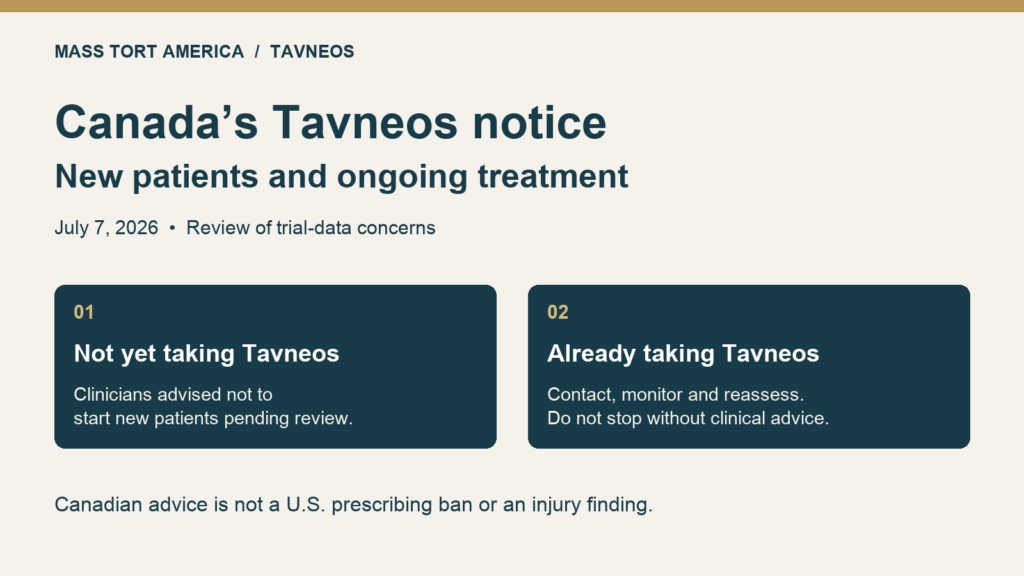
A person about to take a first dose of Tavneos and a person already taking it face different questions. Canada’s July notice addresses both. Its advice is not simply “stop the drug.” Health Canada’s Tavneos notice makes that distinction: it advises clinicians not to start new patients on avacopan while the agency reviews concerns about the trial data behind approval. For people already taking it, the notice calls for contact, monitoring and an assessment of whether treatment should continue—not an unsupervised stop.
The reason for the Canadian review is worth reading before drawing conclusions from its headline. Health Canada is questioning the trial evidence used to show that Tavneos works. It is not announcing another set of liver injury cases in this notice. For someone recovering from a liver injury, that leaves two separate issues to discuss: the evidence behind approval and what happened during their own treatment. That difference matters to families trying to understand what a regulatory warning can, and cannot, establish in a Tavneos liver injury claim.
What Canada’s notice asks doctors to do
The concern starts before a patient ever filled a prescription. Health Canada says the main study supporting Canadian authorization was ADVOCATE, and that questions have emerged about how its data were handled before approval. The uncertain part is the proof of efficacy: did the study reliably establish how well the medicine works? The agency is weighing that uncertainty together with Tavneos’s known risks. This is not a claim that every participant’s experience was the same.
Its advice separates two situations:
Before treatment starts: The notice advises healthcare professionals not to initiate Tavneos in new patients while the review is pending. A family should take a proposed first prescription back to the prescriber for a discussion, rather than treat advice for existing patients as permission to start.
During ongoing treatment: The instruction is to contact patients, monitor them and assess whether continuing remains appropriate. It calls for a decision about the individual’s care, not an automatic instruction for all current patients to discard their medicine.
The patient-facing part of the same notice matters just as much as its advice to doctors. It says not to stop taking Tavneos without first speaking to a healthcare professional. It also tells current patients to contact that professional about their treatment and whether another therapy might be appropriate. Read those instructions together: ask for a treatment discussion; do not make the switch yourself.
The dates can be easy to miss on a safety-alert page. This communication was originally published on July 7, 2026. We retrieved it again on November 18. The later date is our review date, not a second Canadian announcement. The notice describes a review and interim advice; it does not announce a final withdrawal decision.
The trial retraction answers a different question from a liver diagnosis
There is also a journal decision in the story. Health Canada reports that the New England Journal of Medicine retracted the ADVOCATE publication on June 29, 2026 over data-integrity concerns. That is a statement about the published trial. It should not be read as a judgment about every doctor who prescribed Tavneos or every patient who received it. The Canadian notice makes no such individual finding.
For an injured patient, the distinction is practical. A retracted study cannot tell you what diagnosis belongs in your chart. Nor does the Canadian notice decide that a particular prescriber acted improperly. The approval question concerns reliable evidence of benefit. A personal injury review asks what happened to a particular person and whether the evidence connects that harm to the drug. Do not use an answer to the first question as an answer to the second.
FDA gave its own account on April 27. It says personnel who knew the treatment assignments manipulated the study’s results, making the drug look effective when the original analysis did not support that conclusion. It also says the original analysis was withheld from the agency. Those are serious regulatory assertions. We attribute them to FDA because a withdrawal proposal is not a verdict resolving an individual patient’s lawsuit.
Amgen’s response should be read alongside FDA’s statement, not mistaken for an agency decision. The company disputes the proposed withdrawal. Its FAQ describes an independent review by Duke Clinical Research Institute experts and says the results were generally similar to the original trial results. Amgen relies on that review in defending Tavneos. The FAQ does not establish that FDA has accepted the company’s position or closed the withdrawal process.
Where the liver-injury evidence comes from
The source for the liver warning is FDA’s March 31 safety communication, not Canada’s July data-integrity notice. FDA describes serious drug-induced liver injuries associated with Tavneos, including fatal cases. It also describes vanishing bile duct syndrome, in which bile ducts in the liver are progressively destroyed and disappear. That is the safety evidence a reader should consult when asking why liver harm is being investigated.
Keep the two documents separate when discussing them with a doctor or lawyer. Canada’s July notice concerns the reliability of evidence for benefit. FDA’s March communication concerns liver harm associated with use. Calling both simply “the recall” loses what each actually says. Neither is a diagnosis of the reader, and neither announces compensation for that reader.
Our explanation of the U.S. Tavneos registry study covers another type of evidence: findings in a defined group of treated patients. For a personal claim review, a lawyer still needs to understand the person’s exposure and diagnosed injury rather than infer them from a foreign notice or a retracted paper.
What a U.S. patient should take from the Canadian advice
The Canadian instruction is not a U.S. prescribing ban. FDA’s published proposal says Tavneos remains on the market unless the applicant removes it or the FDA Commissioner mandates removal. Amgen’s FAQ, checked for this article, continues to describe U.S. availability.
A useful question for the prescribing clinician is: “How do the doubts about the trial and the liver warning affect my treatment options?” That leaves the decision with the person who knows the patient’s condition, other medicines and care plan. It does not ask the patient to resolve a regulatory dispute alone.
Do not wait for that dispute to end if possible liver symptoms appear. FDA tells patients to contact a healthcare professional immediately for symptoms that may indicate liver injury, including yellowing skin or eyes, unusual itching, dark urine or right-upper-abdominal pain. Discuss treatment changes with the treating clinician.
Sources
- Health Canada: Tavneos data-integrity communication, July 7, 2026
- FDA: proposal to withdraw Tavneos approval, April 27, 2026
- FDA: serious liver injury safety communication, March 31, 2026
- Amgen: Tavneos patient questions and response to FDA
Attorney advertising. This article is general information, not medical or legal advice. Reading it does not create an attorney-client relationship. Compensation and outcomes are not guaranteed. Do not change prescribed treatment without consulting your healthcare professional.

Robert B. Baker, Esq., B.C.S. — Board-Certified Civil Trial Lawyer. 30+ years of trial experience, more than $400 million recovered for clients. About Robert Baker →
This website provides general information. Your circumstances require an individual review.